A growing collection of practical SEO tools built to help marketers, business owners, and developers complete everyday optimization tasks faster, catch issues earlier, and make smarter decisions without another paid subscription.
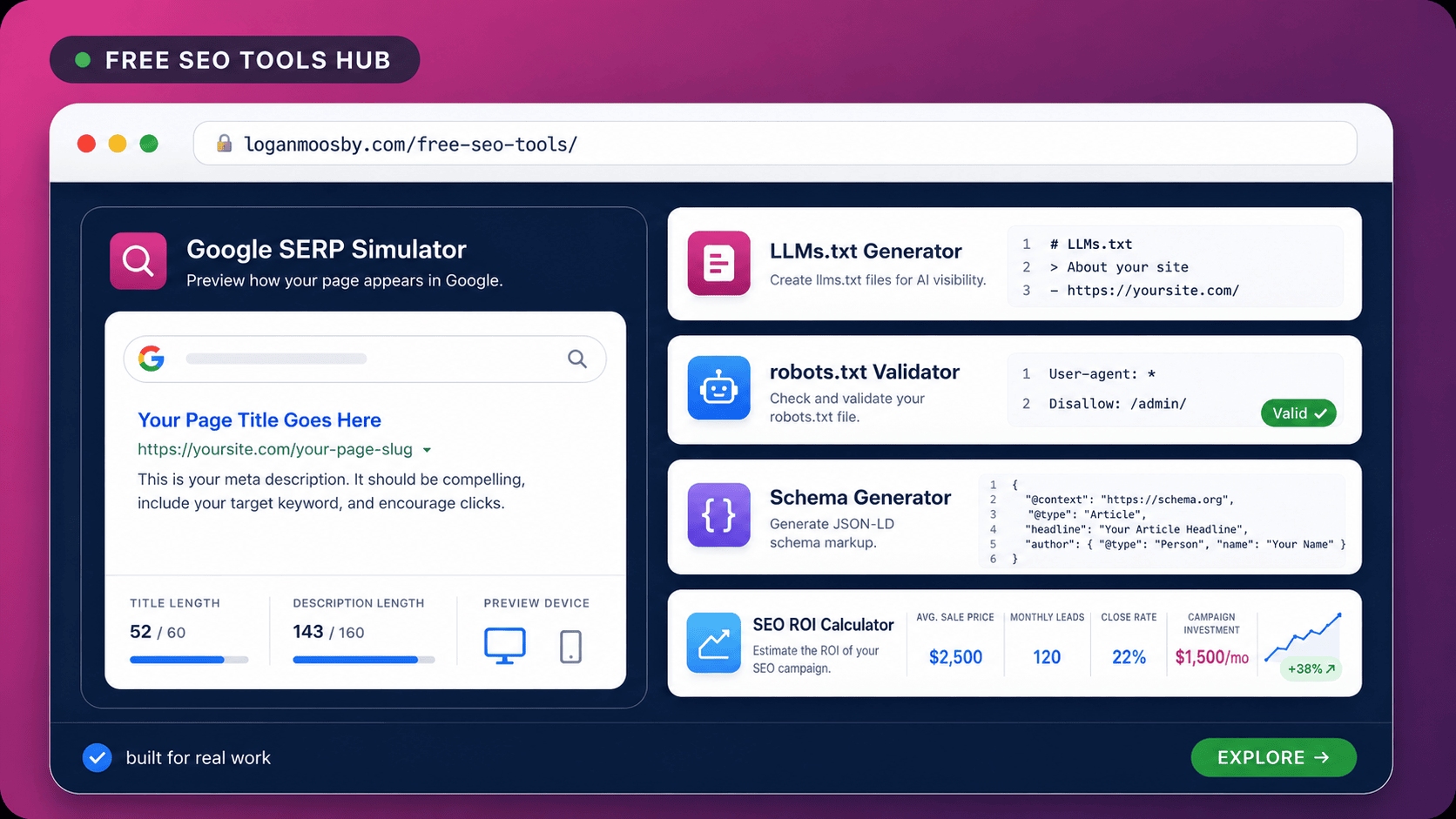
This file is relatively new and while no system has confirmed or denied that they use it, I’ve decided it can’t hurt and may add additional value. I am also testing the efficacy of this to see if there is increased bot activity on sites where it is implemented. That said, build a spec correct llms.txt file, checked field by field against the real llmstxt.org standard, ready to copy, download, and drop at your domain root.
Check what search engines and AI crawlers can actually reach. Paste your robots.txt and catch blocked pages, syntax errors, and conflicting rules before they cost you rankings.
Build spec correct JSON-LD structured data without touching a line of code. Fill in the fields and get clean schema markup ready to paste straight into your site.
Preview exactly how your title tag and meta description render in Google search results before you publish, so you stop guessing at pixel widths and truncation.
Estimate what more organic traffic could actually be worth to your business, translating rankings and clicks into revenue numbers your team can act on.
These tools solve one problem at a time. If you want all of it handled, audits, technical fixes, content, and reporting, let’s talk.
Here’s what happens when you run each of these free SEO tools, and what you get back.
Paste in your robots.txt, or enter your domain and it gets pulled for you.
It’s checked line by line against the actual robots exclusion protocol.
You get a plain readout of what’s blocked, what’s allowed, and any syntax or crawler specific issues, including AI bots like GPTBot.
Pick the schema type you need, Article, LocalBusiness, or FAQ (for now).
Fill in guided fields. No code, no guessing at property names.
Copy out spec correct JSON-LD, ready to drop into your site or CMS.
Enter your title tag and meta description.
See a live, pixel accurate preview of how it renders on desktop and mobile.
Get flagged before Google truncates your copy, so you can fix it before it goes live.
Enter your site info and the pages you want AI tools to prioritize.
It’s formatted to the real llms.txt spec, not a guess at one.
Every field gets validated against the spec, then you copy or download the finished file.
Enter your average sale price, close rate, and average monthly lead volume.
Select an investment level for your campaign.
Get an estimated revenue impact you can actually bring into a budget conversation.
For a lot of day-to-day checks, no. These tools handle the mechanical stuff, crawlability, schema, snippet previews, llms.txt, and ROI math, accurately and for free. Paid platforms like Ahrefs or Screaming Frog earn their price on large scale crawls, historical data, and competitor research that these tools don’t attempt to replace.
Each tool checks your input against the actual published rules, the robots exclusion protocol, the schema.org spec, or the llmstxt.org standard, so the validation itself is accurate. What you won’t get is the massive crawled databases paid tools use for things like backlink indexes or historical ranking data. Different job, different tool.
Not directly, and anyone who tells you it does is guessing. llms.txt isn’t a confirmed Google ranking factor. What it does is give AI tools like ChatGPT and Claude a clean, curated map of your best pages, which matters more for how those tools cite and reference you than for traditional search rankings.
Any time you launch a new site section, switch your CMS or page builder, or make a big structural change. Plugin and theme updates are a common, quiet way robots.txt rules or schema markup get overwritten without anyone noticing.
Right now it covers Article, LocalBusiness, and FAQ schema, the types that cover the most common real-world use cases. More types are on the way. If you need something specific that isn’t listed yet, reach out and I’ll build it.
Yes. No email gate, no trial that locks up after a few uses, no upsell popup. I built these because I use them myself for client audits, and figured other people doing SEO work could use them too.

Honestly, I built these mostly to see if I could. But there’s also a real gap out there, which is a lot of the free SEO tools floating around are inaccurate, outdated, or built to funnel you into an email list where you are bombarded non-stop to pay some fee. I wanted something better, so I am working on building it.
All of these tools are free to use, with no email gates and no upsells. If one of these makes your day a little easier, that’s the whole point.
These tools handle the mechanical checks accurately and for free. Paid platforms earn their price somewhere else entirely. Here’s the honest split.
Robots.txt syntax and crawler specific rules, including AI bots like GPTBot
Spec correct JSON-LD schema markup, ready to paste in
Title tag and meta description previews before you publish
llms.txt file generation, validated against the real spec
Ballpark ROI math for what more organic traffic is worth
Backlink indexes and referring domain data
Historical ranking and traffic trends over time
Competitor keyword gaps and content opportunities
Large scale automated crawls across thousands of pages
Ongoing rank tracking across hundreds of keywords
Different job, different tool. These handle the mechanical checks. Paid platforms handle the competitive intelligence.